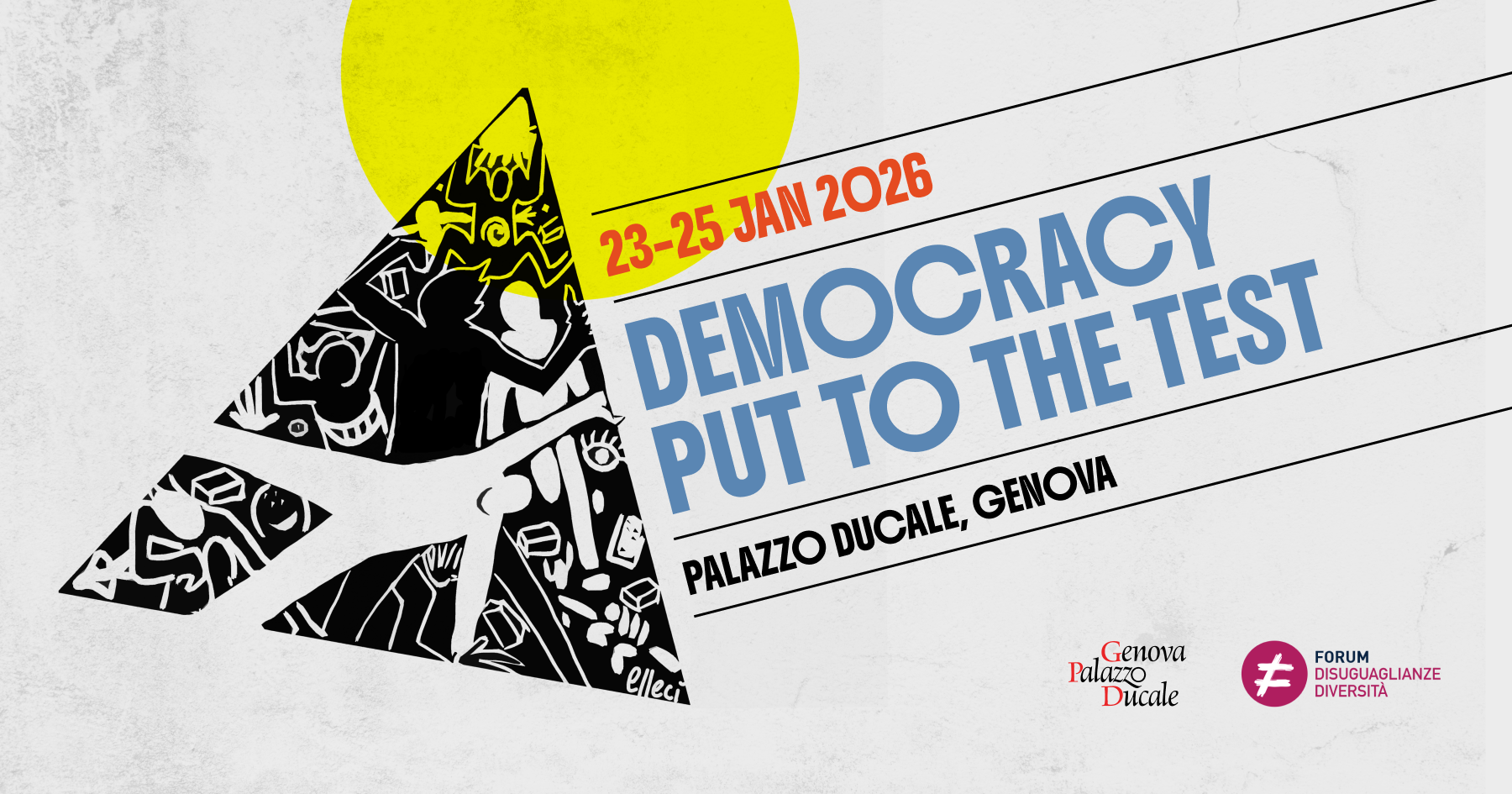
Forum Disuguaglianze e Diversità e Palazzo Ducale Fondazione per la Cultura promote a three-day event, curated by Fabrizio Barca and Luca Borzani, to understand the challenges to democracy and its capacity to react and regenerate itself. Guests include: Gaetano Azzariti, Vincent Bevins, Lucio Caracciolo, Massimo Florio, Jayati Ghosh, Evgeny Morozov, Serena Sorrentino, Susan Stokes, Nadia Urbinati, Chiara Volpato
In the face of a social and political transformation marked by deep complexity, the direction taken by digital transformation, an extraordinary concentration of wealth and power in a few hands, a powerful authoritarian dynamic penetrating democracy, and its coexistence with neoliberalism, can democracy renew its mechanisms? How? These questions will be at the centre of the three-day event “Democracy put to the test” organized by Forum Disuguaglianze e Diversità and Palazzo Ducale, that will take place at Palazzo Ducale in Genova from 23 to 25 January 2026. The perspective is not the exhausting one of the “crisis of democracy”, since democracy, by its own nature, is never a given, but is a system that legitimizes and governs conflicts and tensions, and thus it is in a permanent state of change and must continuously adapt its mechanisms to the context and regenerate. The problem today is the delay in this adaptation.
The starting point is provided by a set of assumptions, curated by Fabrizio Barca and Luca Borzani, which will be challenged during the three-day event. There will be presentations on the United States, India, China and Italy, as well as the point of view of young generations on democracy put to the test. The discussion between speakers from different disciplines and fields of action, from all generations and different countries, will help to understand “what to do”.
The document
The document, (also available in Italian), discusses several issues, which will be used as a starting point for a discussion on the need for democracy to regenerate itself and how this process can be achieved.
These are the main points, by title:
- By ‘democracy’, we mean a constitutional system that aims to ensure that all members of society have an effective weight in public decision making, the possibility of not being dominated or subordinated, and a common equality.
- Democracy is never a given, but it is by its nature a system in a permanent state of change that must govern tensions and thus continuously adapt to the context.
- Democracy, although not necessary for capitalism, can coexist with and influence it.
- Neoliberalism has eroded democracy’s ability to achieve its objectives.
- Neoliberalism has also been able to harness and bias the digital transition into a tool to concentrate wealth and power.
- Democracy failed to adapt its tools to the increasing complexity of public decision-making.
- The existing tools of public debate and control have been impoverished, with the effect of boosting the authoritarian direction.
- Several movements and active citizens organizations, with a significant role of new generations, have opposed neoliberalism, but have not scaled up to a systemic level.
- Neoliberalism has progressively lost its hegemony, and has accentuated its illiberal character. In the absence of a concrete alternative proposal for developing democracy, the authoritarian version of populism has often prevailed.
- The current phase can be interpreted as a convergence of neoliberalism and authoritarianism.
- The authoritarian dynamic is cemented and emboldened by a powerful influence on common sense.
It is on the basis of these statements, and the scenario they outline, that democracy is challenged to renew its mechanisms, demonstrating its ability to govern increased complexity in order to achieve a greater social and environmental justice, and to empower decision-making processes and the production of fundamental public goods built through a democratic exchange of values, interests and knowledge.
The five sessions
The three-day event will feature a mix of analysis and dialogues: it will begin on the afternoon of 23 January at 5:30 p.m. and conclude at 1:30 p.m. on Sunday, 25 January.
The first two sessions “Democracy, the State, neoliberalism and authoritarianism: past and present” and “Democracy, the State, neoliberalism and authoritarianism: future” intersect each other by looking at the same events from two different perspectives: the state of the art today and how it came about; the foreseeable future. In the first session, the inquiry concerns mostly the issues to which neoliberalism first, and authoritarianism later, have given answers that democracy was failing to provide. It also addresses the reasons why these have become hegemonic and have started to coexist, and the main features of the authoritarian dynamic. The second session, discusses mostly whether and how democracy has tried to react and can still react to the current test and whether and how the current imbalance of social, economic and political power can be changed: attention will be paid to the governance of public decision-making and to the role and interaction of culture/communication and digital technology.
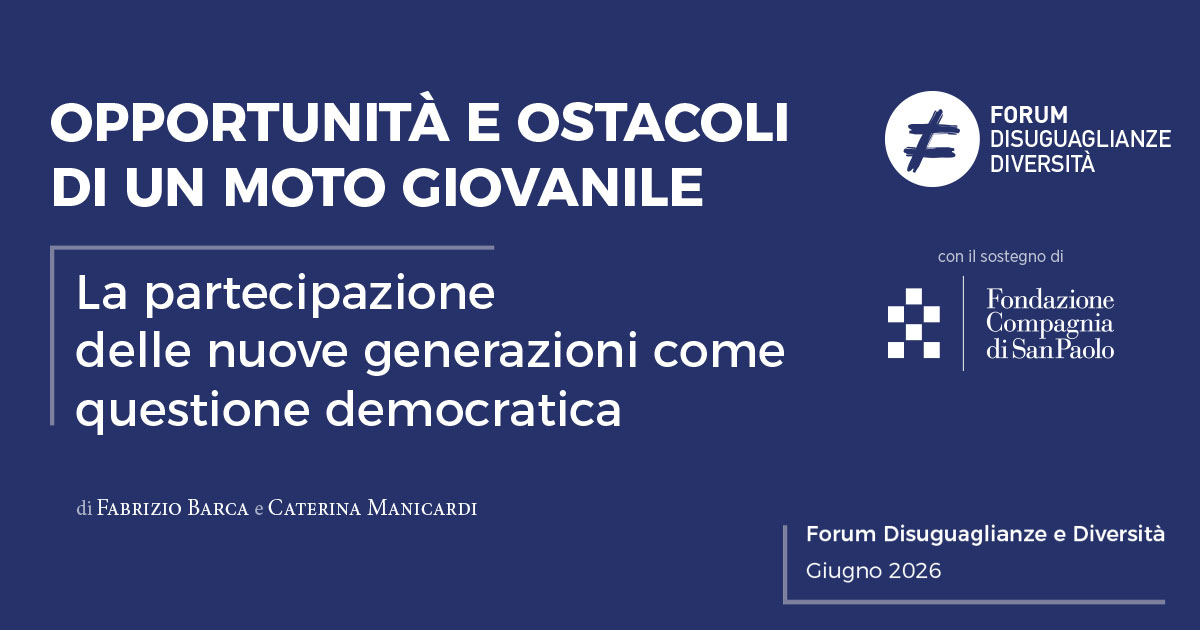
In the third session, “New generations and democracy” the perspective of new generations is adopted: the closure of democratic spaces where a fruitful intergenerational debate/conflict can take place; visions and ideas for renewing democracy coming from youth movements and experiences; their widespread distrust in political organizations and the risk of growing indifference.
In the fourth session, “United States, India and China” we tackle head-on the case of the United States and ask ourselves what the main features of the authoritarian breakthrough are, whether there are signs and chances of a reaction, and to what extent the radical and fast nature of the breakthrough is due to specific traits and the profound crisis of that nation, or rather if it once again signals its anticipatory capacity. By acknowledging that we live in the century of Asia, we also address similar questions for the world’s largest democracy, India, and focus on the unique authoritarian model of China, enquiring into the features of its decision-making process.
The three-day event concludes with a fifth session that tackles the case of Italy. We inquire into the premises and specificities of the ongoing authoritarian dynamic, its connections with Italian capitalism and society, the causes of a high rise in electoral absenteism, the challenge of changing the current common sense, and opportunities for radical political reaction by organized labor, active citizenship, and political parties.
The speakers
Melissa Aglietti (freelance journalist e videomaker), Gaetano Azzariti (Università Sapienza, Roma), Filippo Barbera (Università di Torino, Forum Disuguaglianze e Diversità), Vincent Bevins (journalist e writer), Lucio Caracciolo (Limes Magazine), Lorenzo Cirino (Scomodo), Angela Condello (Università di Messina), Eugenio Damasio (No Panic Agency), Juan Carlos De Martin (Politecnico di Torino), Massimo Florio (Università di Milano e Forum Disuguaglianze e Diversità), Guido Formigoni (Università IULM, Milano), Raffaele Giuliani (Content creator), Jayati Ghosh (Jawaharlal Nehru University, New Delhi – in connection from India), Elena Granaglia (Università Roma Tre, Forum Disuguaglianze e Diversità), Ismahan Hassen (Dedalus – Centro interculturale Officine Gomitoli), Piero Ignazi (Università di Bologna), Alba Lala (Coordinamento Nazionale Nuove Generazioni Italiane), Fulvio Lorefice (Bistoncini Partners), Federico Masini (Università Sapienza, Roma), Alfio Mastropaolo (Università di Torino), Serena Mazzini (digital media expert), Andrea Morniroli (Dedalus Cooperativa, Forum Disuguaglianze e Diversità), Evgeny Morozov (scrittore), Ugo Pagano (Università di Siena e Forum Disuguaglianze e Diversità), Gloria Riva (journalist), Gea Scancarello (journalist), Serena Sorrentino (Cgil), Susan Stokes (Chicago University, Chicago, in connection from U.S.), Carmelo Traina (Questa è la mia Terra), Nadia Urbinati (Columbia University, New York), Chiara Volpato (Università di Milano-Bicocca), Alessia Zabatino (Forum Disuguaglianze e Diversità), Lorenzo Zamponi (Scuola Normale Superiore di Firenze, Jacobin). The three days will be accompanied by daily commentary from Mattia Diletti (political sociologist) and Franco Monaco (journalist) and interviews with participants.
The poster design is by Lorenzo Calza, screenwriter and cartoonist. The graphic design is by the No Panic communications agency, which is part of the entire initiative.